
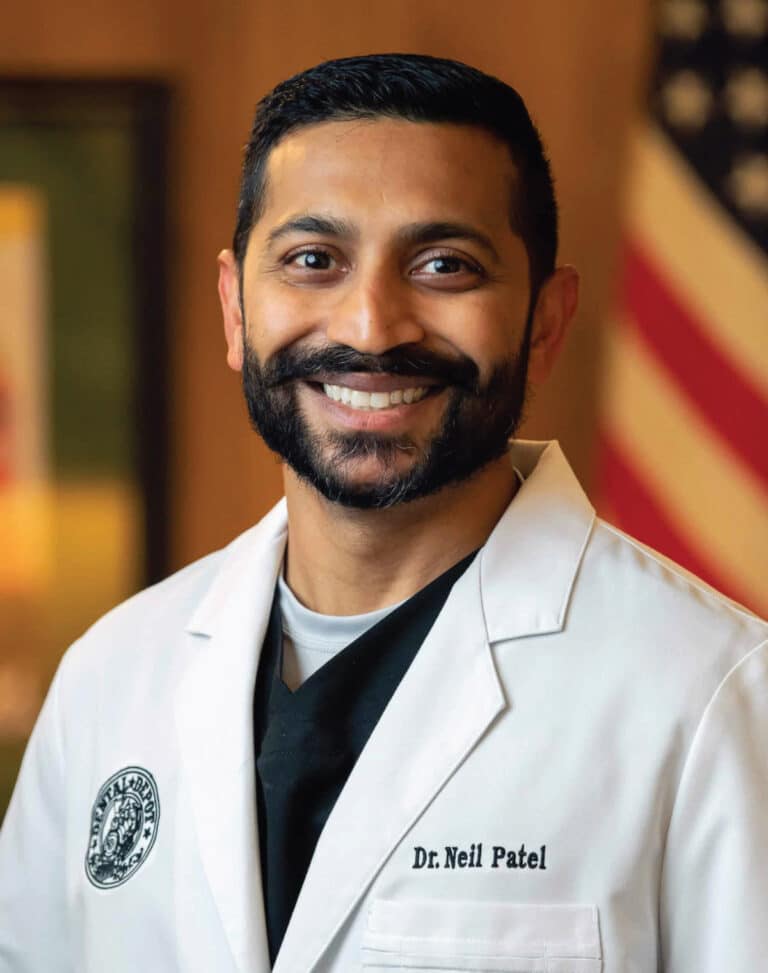
For Dr. Neil Patel, a dental implant specialist at Dental Depot DFW, professional competency means more than just being good at your job—it’s training to be exceptional, pursuing constant improvement, and teaching others to do the same.
In the 18 years since Dr. Patel began practicing implant dentistry, he has logged more than 1100 hours of continuing education in implantology and taught at over 52 training courses for other professionals to become one of the country’s leading experts in his field.
Dr. Patel knew early on that he had a passion for helping people and was drawn to dentistry in particular as a way to both treat medical needs and work with his hands. After receiving his undergraduate degree from the University of Oklahoma in Norman, Oklahoma, Dr. Patel earned his Doctor of Dental Medicine degree from Tufts University School of Dental Medicine in Boston in 2005 before joining the team at Dental Depot of DFW in early 2007.
When a person loses a tooth—or multiple teeth—they lose a part of their body and some level of functionality. They may have to change what or how they eat and may have to compromise some aspect of their lifestyle. Moreover, missing teeth can cause serious problems in the future, leading to issues like infection, further deterioration of the jaw, weakening of remaining teeth, speech and breathing complications, and changes in the facial structure.
Dental implants are unique from other dental devices because they are designed to support and sustain themselves as a single restoration unit or full arch fixed supported restoration. By recreating the function, aesthetics, and stimulation of a full, natural set of teeth, dental implants help tooth loss patients return to a better quality of life, from improved nutrition to better mental health. Described by Dr. Patel as more of a root replacement than a tooth replacement, implants help restore and maintain the structural integrity and symmetry of the face by being placed below the gum line and serving as the foundation for an artificial crown or full arch restoration hybrid.
Implant dentistry also spans a broader scope than simply tooth or root replacements. With restoration options that range from single-unit crowns to fixed-full arch hybrids, implants can be used to help support and retain existing oral bone and tissue that is slowly deteriorating to help stabilize and rebuild lost tissue. This is important to help maintain patient facial aesthetics and help prevent soft tissue from collapsing over time. Implants can also be used to help secure dentures that don’t retain properly, and they are an ideal option for patients who require extensive dental work on natural teeth. Patients with severe gum disease, periodontal disease, or rapid decay often feel like giving up on their natural teeth, opting for something like implants that are lower maintenance and can never decay. In these cases, dental implants can do wonders for a person’s self-esteem, which Dr. Patel says is absolutely critical.
Advancements in technology have dramatically improved the predictability and accessibility of dental implant procedures. According to Dr. Patel, nearly 98% of the patients he sees who are missing a tooth or multiple teeth are candidates for implants, even if they’ve been told they weren’t in the past, primarily because newer technology allows the specialist to see below the gum tissue to determine exactly how much natural bone is still present. With more conservative, less invasive, and more precise treatment options available, a patient’s candidacy for dental implants can now be based on how to augment what they already have, not only on what they’re missing.
The advent of digital Cone Beam 3D technology (CBCT) has transformed implant treatment planning by allowing providers such as Dr. Patel to evaluate a patient’s anatomy in three dimensions rather than relying solely on traditional 2D imaging. When combined with intraoral scanning, CBCT creates a comprehensive virtual model of the patient that can be used to plan procedures digitally before surgery takes place. This technology supports highly precise, minimally invasive treatment by allowing the desired restorative outcome to be designed first and then guiding implant placement based on the patient’s anatomical needs and treatment goals.
Digital CBCT also helps deliver more predictability, reliability, and safety to the dental implant procedure process. During consultations, they offer immediate feedback for the dentist and for the patient to see and understand the process more intuitively. During implant procedures, digital CBCTs assist the surgeon in guiding implants into the ideal location and determining how deep into the jaw the implant is placed.
Soft tissue laser treatment uses a pen-style holder to remove soft tissue more predictably making it more effective, gentle, and precise in removing and shaping the soft tissues of the mouth, which often translates to better recovery and better results. Soft tissue laser treatment doesn’t harm hard dental tissue or the dental pulp and typically only requires minimal local anesthetic, helping the body maintain excellent hemostasis.
This is significant for Dr. Patel, who notes that before these new techniques were available, much of the patient’s gum and jaw had to be surgically reflected to determine how to position implants, and, as he puts it, “the more you deconstruct, the more you have to reconstruct.”
With soft tissue laser treatment, patients experience less physical stress during the implant procedure and few even need pain medication following it.
Using a wand moved around inside the mouth, intraoral 3D imaging helps give patients a view of their mouth in real-time with a magnification level of up to 30x, allowing them to see every aspect of each tooth. This in-depth look at their oral health helps better educate patients so they can understand their diagnosis and treatment options more clearly, make more informed decisions, and minimize or even eliminate any uncertainty they may have, including giving them a glimpse into the future.
“We don’t just place the implant and see what happens,” says Dr. Patel. “With 3D imaging and scanning, we can show patients what they will look like after treatment. That extra step just makes everything more precise and predictable.”
Dr. Patel is adamant that if you learn to do something well, then you should teach others how to do it well, too. Partnering with MegaGen, a leading implant device manufacturer, Dr. Patel visits the company’s various locations throughout different regions of the country teaching continuing education courses to other dental professionals. He teaches two or three of his 64-hour courses a year, traveling to regional hubs in Mexico and Dallas with Foundation Implant Training (FIT).
Patient education is also central to long-term success with dental implants, and Dr. Patel works hard to make sure his patients are involved and informed throughout the entire process. Taking the time to consult with patients in a calm, relaxed environment, answering every question and guiding them through their diagnosis and treatment, helps take the stress and uncertainty out of a procedure that can be deeply personal and emotional and gives patients the confidence they need to take charge of their dental health.
“Our goal is to get patients back to what they want,” explains Dr. Patel. “We find out where they want to be, then we reverse engineer to see what we need to do to make that happen.”
Dr. Patel emphasizes that implant dentistry is highly individualized and that treatment planning must be tailored to each patient’s unique anatomy, oral health, and restorative goals. Dental implants are custom-designed for each person, and the amount and quality of existing natural bone and soft tissue play a significant role in determining treatment options, healing requirements, and overall timelines. His approach places a strong emphasis on regenerating lost bone and soft tissue naturally whenever possible, helping create a stable foundation for long-term implant success while minimizing inflammation and complications.
According to Dr. Patel, his implant cases have achieved an overall success rate approaching 97%, which he attributes to detailed treatment planning, established clinical protocols, and careful attention throughout every stage of care.
“We don’t take shortcuts or cut corners. We do things a certain way and only a certain way to make sure it’s done right the first time,” says Dr. Patel.
At the same time, he notes that implant complications can occur and that identifying the underlying cause is an important part of successful treatment. When early signs of implant failure are detected, corrective measures may include removing the implant, performing additional grafting if necessary, and replacing the implant to support a successful long-term outcome.
“If there was a problem, there’s always a reason why the problem occurred and we can correct it,” he says. “If we see early indications that an implant could have some sort of failure, we take out the implant, regraft if needed, and replace it at no additional cost.”
Dr. Patel also believes it is important for patients to understand the sheer range of treatment possibilities available through implant dentistry and the impact it can have on a person’s life. Whether replacing a single tooth, multiple teeth, or an entire arch, implant treatment can often help save whatever natural bone and tissue a patient already has left, restore oral function, support long-term oral health, and improve overall quality of life. Many patients report meaningful improvements following treatment, leading friends and family members to explore implant options for their own dental concerns.
“Our patient’s experience with our team leads to most of our new implant referrals, which is a very humbling compliment to our team and process,” says Dr. Patel.
Dental Depot of DFW is a comprehensive dental care provider with a unique composition: in addition to fully trained, experienced dentists and dental hygienists, the Dental Depot staff also includes specialists like an oral and maxillofacial surgeon, a prosthodontist, and an orthodontist.
A member of the Dental Depot DFW team since its doors opened in 2007, Dr. Patel lauds the invaluable benefits of this multidisciplinary staff for both patients and physicians, primarily how having multiple specialists under one roof translates directly into exceptional patient convenience. Patients requiring comprehensive multifaceted treatment, for example, can receive implant procedures while undergoing orthodontic therapy, so they can complete all of their dental work necessary within months and with the same team, instead of dragging the treatment out over years visiting different practices.
If you or someone you love needs dental work of any kind, Dr. Patel and the team at Dental Depot of DFW can help you retain and preserve what you have while improving your overall health and quality of life. Schedule a consultation at any of our area locations today! It’s never too late to have the smile you deserve.