
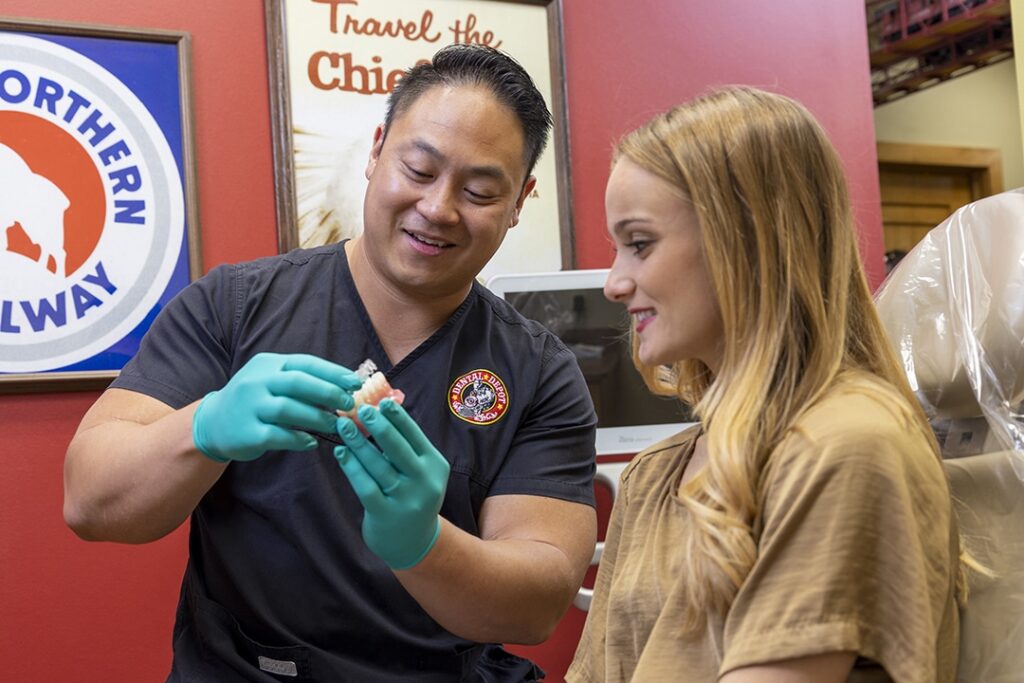
Even after orthodontic treatment is complete, your teeth and the structures that support them need ongoing stability to maintain their new alignment. Retainers hold teeth in place while the surrounding bone and tissues finish adapting and help protect your smile from everyday forces like chewing, speaking, and natural changes over time. Because teeth can continue to shift long after braces or Invisalign treatment ends, wearing a retainer as recommended is the most reliable way to preserve your results, maintain a comfortable bite, and keep your smile healthy and well-aligned for the long term.
Retainers are important because they:
At Dental Depot of DFW, orthodontic care is designed with the future in mind, helping patients not only achieve straight teeth, but keep them that way. Our doctor-directed approach combines advanced digital tools with comprehensive, in-house care to support every stage of treatment, from initial planning through long-term retention. By using modern scanning and fabrication technologies and maintaining continuity across all of our DFW locations, we’re able to provide reliable retainer solutions and ongoing, commonsense guidance that fits seamlessly into your busy life and helps protect your smile well beyond the end of active treatment. It’s just another way Dental Depot of DFW stays committed to delivering affordable, accessible, and comprehensive dental care services for patients of all ages and stages of life.
When orthodontic treatment is finished—whether you’ve worn braces or completed a series of clear aligners—it’s natural to feel like the process is complete. Your teeth look straight, your bite feels better, and the active part of treatment is behind you. However, this stage is really a transition rather than a stopping point.
During orthodontic treatment, teeth are guided into new positions using steady, controlled pressure. As this happens, the bone and tissues around the teeth adjust to support those changes. While teeth can move into alignment relatively quickly, the supporting structures need more time to fully settle and strengthen. When braces are removed or aligner treatment ends, your teeth may look finished, but the tissues around them are still adapting.
When you reach the end of your orthodontic treatment, your dentist takes a close look at how your teeth are sitting together, how your bite functions, and which areas may be more likely to shift over time. Habits like clenching or grinding are also considered. Based on this evaluation, a retainer plan is created that’s designed specifically for your smile and your needs.
Retainers help hold your teeth in place while your body completes the adjustment process. They give your smile the support it needs so the changes made during treatment can last. Without that support, everyday forces—like chewing, speaking, or even the way your tongue rests—can slowly influence tooth position again.
Because every smile is different, some patients do best with a removable retainer, others with a fixed retainer, and many with a combination of both. The goal is always the same: to protect your results in a way that fits comfortably into your daily life and keeps your smile looking and functioning its best.
Whether orthodontic treatment was completed with braces or clear aligners, retainers play an important role in protecting the outcome. Straight teeth don’t stay that way on their own, especially in the months and years following treatment, and retainers help keep everything working together—your teeth, your bite, and the supporting structures that hold them in place—so the results you have achieved remain stable and comfortable over time. When worn as recommended, retainers provide the ongoing support that helps your smile hold up to everyday use.
Orthodontic treatment is a process, not a moment in time. Retainers help carry that process forward by keeping teeth where they were carefully guided to go. Day-to-day activities like eating, talking, and even sleeping place pressure on your teeth, and retainers help counterbalance those forces. By maintaining alignment consistently, retainers help ensure your smile looks and feels the way it should long after treatment ends.
Although teeth may look straight when treatment is finished, the structures that support them beneath the surface are continuing to adjust. Retainers provide steady support during this settling period, allowing your body to reinforce the new positions naturally. This added stability helps reduce unnecessary strain on the teeth and surrounding tissues. Giving your smile this time to fully adapt helps make the results more secure and comfortable in the long run.
Some areas of the mouth are more prone to movement than others, particularly the lower front teeth. Retainers help reinforce these areas by maintaining gentle, consistent positioning throughout the day or night. This targeted support is especially important for keeping smaller, more delicate alignment changes intact. It’s a simple way to protect the areas that tend to work the hardest.
Orthodontic treatment doesn’t just straighten teeth; it helps improve how your bite comes together. Retainers help preserve that balance by keeping teeth in positions that allow them to work together comfortably. A stable bite supports more even chewing and helps reduce uneven wear on teeth over time. Maintaining proper bite alignment also contributes to overall comfort in daily activities.
When teeth stay properly aligned, brushing and flossing tend to be more effective and consistent. Retainers help preserve spacing and alignment that make it easier to reach all tooth surfaces during daily hygiene. This can support healthier gums and help reduce areas where plaque tends to collect. Over time, this contributes to better oral health with less effort.
Changes in the mouth don’t stop after orthodontic treatment. Over the years, natural shifts in the jaw, dental wear, and other life changes can influence tooth position. Retainers offer a way to manage those changes proactively rather than reactively. By continuing to support alignment, retainers help your smile stay steady as the rest of your body changes.
When retainers aren’t worn as recommended, teeth can gradually begin to move out of alignment. This doesn’t usually happen all at once. In many cases, the changes start small and are easy to miss at first, especially if they develop slowly over time. You might notice that your teeth don’t feel quite the same when you bite down, or that your retainer feels tighter than it used to.
Without consistent retainer wear, teeth can begin to crowd, small spaces may open, or the bite may shift slightly. Changes in smile symmetry can also occur, and once a retainer no longer fits properly, it’s often a sign that movement has already taken place.
Teeth can start shifting sooner than many patients expect. Without a retainer, minor movement can begin within just a few weeks, particularly in the lower front teeth, which are naturally more prone to crowding. Over the course of a few months, those small changes can become more noticeable, and after a longer period without retention, movement may reach a point where it affects how your teeth look or how your bite functions.
At that point, simply putting a retainer back in may not be enough to correct the problem. Additional orthodontic treatment may be needed to restore proper alignment. Wearing your retainer as recommended helps prevent these changes before they happen, making it much easier to maintain the results you worked hard to achieve.
After orthodontic treatment, one of the most common questions patients ask is how long they’ll need to wear a retainer. The answer often surprises people, because retention isn’t a short phase with a clear finish line—it’s an ongoing part of protecting the results you’ve worked hard to achieve. Most patients begin with full-time retainer wear for a period after treatment, then transition to wearing it at night. Since teeth can continue to shift at any age, though, consistent nighttime wear is the most reliable way to keep your smile stable over the long term.
Retainers generally fall into two main categories—fixed and removable—and each plays a different role in maintaining alignment. The right option depends on how your teeth have moved during treatment, which areas need the most support, and what fits best into your daily routine. In many cases, patients benefit from using both.
Fixed retainers are thin wires bonded to the back surfaces of selected teeth, most commonly the lower front teeth. Because they remain in place at all times, they provide continuous stabilization without requiring daily wear decisions.
Fixed retainers are often used to:
Fixed retainers require careful brushing and flossing around the wire, and are typically checked during routine dental visits. While they can last many years, fixed retainers may require occasional repair.
Removable retainers are designed to be taken in and out and are commonly used both immediately after treatment and for the long term. These retainers help maintain overall alignment and allow flexibility as wear schedules change over time.
Common types of removable retainers include clear plastic retainers and Hawley retainers, which combine acrylic with a thin metal wire.
A typical wear schedule for removable retainers may include full-time wear for several months after treatment, then a transition to nighttime wear for long-term stability.
After braces, retainer selection is based on how the teeth responded to treatment and which areas need the most long-term support. You may receive a removable retainer to maintain overall alignment, a fixed retainer to stabilize specific teeth, or a combination of both, an approach that allows for flexibility while focusing on long-term results.
Clear aligner treatment still requires careful retention, and precision remains important after the final aligner is finished. Because aligners move teeth in small, planned increments, retainers help ensure those final positions are maintained comfortably and predictably over time.
Many Invisalign patients use either clear retainers shaped to their final alignment, or Vivera® retainers, which are designed for durability and consistent fit.
At Dental Depot of DFW, we treat retention as an essential part of orthodontic care, not an afterthought. When active treatment ends, our focus shifts to protecting your results with the same level of planning and precision that guided your braces or Invisalign treatment.
We use digital scans and computer-guided planning to design retainers that closely match your final alignment, eliminating the need for traditional impressions, while our in-house technology, including 3D printing, allows us to create retainers with a precise fit that supports comfort, durability, and long-term stability. And, because your digital records are securely stored, we’re able to maintain consistency in your care over time.
Because we’re a full-service provider that offers comprehensive dental care, retention is also monitored as part of our standard treatment procedures. During routine visits, we check retainer fit, tooth stability, and bite function, making adjustments as needed to help prevent unwanted changes. With multiple locations across the DFW metro, our patients benefit from continuity of care and familiar guidance no matter which office they visit.
As a Platinum Provider of Invisalign and a top orthodontic provider in the DFW area, the team at Dental Depot of DFW has extensive experience not only in creating beautifully aligned smiles, but in helping patients maintain those results long term. If you’re finishing orthodontic treatment or have questions about your retainer, schedule an orthodontic consultation with Dental Depot of DFW to learn how we help protect your smile for the years ahead.