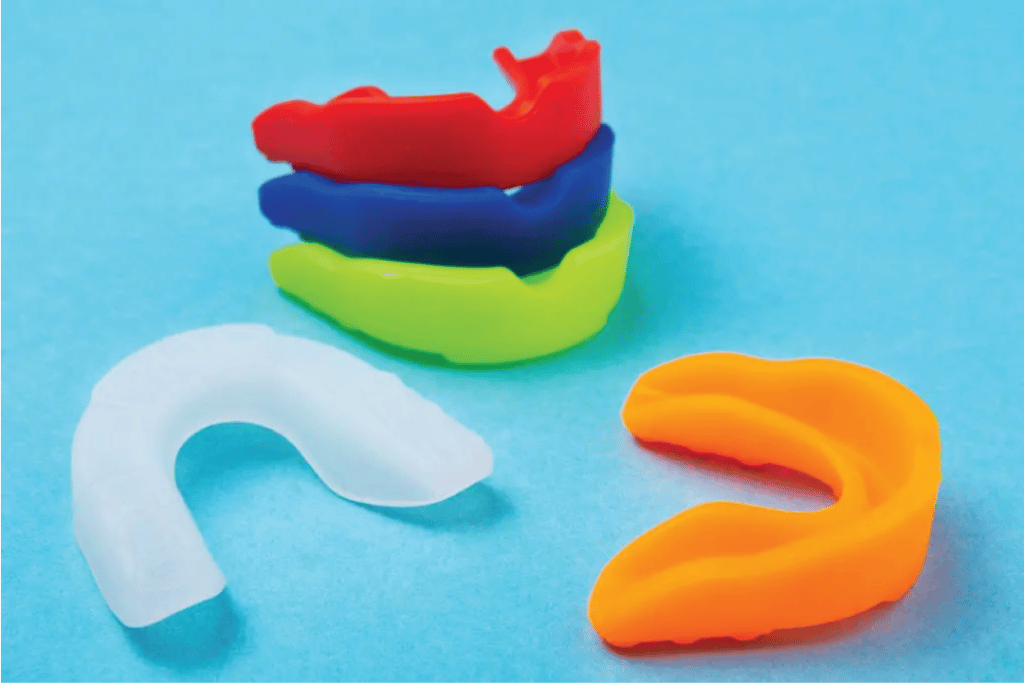
Mouthguards protect your teeth from damage caused by excessive pressure, grinding, or impact, reducing the intensity by absorbing some of the force and spreading it out across a greater area. A mouthguard for bruxism also keeps top and bottom teeth separated, reducing the effect of grinding and clenching.
Mouthguards can also help alleviate mild sleep apnea. Sleep apnea occurs when the tongue and jaw fall out of alignment while sleeping, closing off your airway and causing you to stop breathing temporarily. Sleep apnea is a potentially serious condition that can disrupt your sleep and negatively impact your overall health.
Although they also protect your teeth, sleep apnea devices primarily work by pushing the lower jaw and tongue forward so your airway remains open while you sleep. Some include a strap that goes around the head and chin to re-adjust the lower jaw for a similar effect. This can also help reduce snoring, which can also be a side effect of sleep apnea
Most mouthguards are designed to protect only the upper teeth because these teeth stick out slightly more than the bottom teeth and are at greater risk for impact, but if you require a mouthguard to alleviate bruxism or sleep apnea, or if you have braces, your dentist will likely recommend protection for both the top and bottom teeth.
Any mouthguard you choose should be comfortable, durable, and easy to clean, and it should not impede your breathing or speech.
What types of mouthguards are there?
- Stock. Stock mouthguards are preformed devices that can be found over the counter, and although they come in a variety of sizes, they are not molded to your mouth, so they can be bulky and fit poorly, making it difficult to talk and breathe. Stock mouthguards are the most inexpensive but are best suited for occasional use.
- Boil-and-bite. Boil-and-bite mouthguards are made of a thermoplastic material that can be softened and shaped to fit your mouth by “boiling” the mouthguard and then “biting” into it. This will provide a somewhat better fit than stock mouthguards, but not as snug as a custom-fitted one. Slightly more expensive, these mouthguards can also be found off the shelf and are more suitable for regular use in sports or other high-impact activities.
- Custom-fitted. These mouthguards, available only from a dental or orthodontic professional, are just that—custom-fitted to your mouth. They are made with a mold of your teeth for a mouthguard that fits the structure of your mouth and teeth perfectly. They do cost more, but they offer the best fit and protection and can be designed to fit your specific need, whether that’s protection from injury or for night use to prevent teeth grinding and clenching.
Stock and boil-and-bite mouthguards will be less expensive and can be found at nearly any drugstore or sporting goods store, but they will offer less protection and fit less comfortably than a custom-fitted one. And if you have bruxism or sleep apnea, your dentist will recommend a custom-fitted mouthguard because they fit better, are more comfortable, and easier to keep in place, especially while you sleep.